From Marx to Hamas
Belief in a future heaven, often gives rise to a hell on earth. It hardly gets more absurd than that. Why, throughout human history, do we keep making the same mistakes?
Utterly spellbound, I read the memoir of Ingrid Betancourt, Even Silence Has an End (2010), unable to put it down. For days I found myself in the deep, dark, unpredictable jungles of Colombia, drawn into the brutal world of the Revolutionary Armed Forces of Colombia, FARC-EP (Fuerzas Armadas Revolucionarias de Colombia–Ejército del Pueblo) and their hostages.
One of those captives was Ingrid Betancourt, a French-Colombian politician who, as one guerrillero (Spanish for “fighter”) sneered at her, “stood for everything the FARC despised.”
The former Colombian presidential candidate was held in the seemingly endless jungle for more than six years (2002–2008). There, she became a survivor among mostly young men and women united by an ideology that, in their eyes, justified the use of violence against anyone who did not share it.
I can’t help but wonder: has Dutch ex-guerrillera of the FARC, Tanja Nijmeijer, read her book?
Civil War
The FARC was a Marxist-Leninist guerrilla movement founded in Colombia in 1964. It claimed to fight social inequality and rural poverty, seeking to overthrow the Colombian government and build a communist state in which inequality would cease to exist.
For over forty years, a bloody civil war raged between the FARC and the government. In the 1990s, right-wing paramilitary groups joined the fray — wealthy landowners who had grown frustrated with the government’s inability to defeat the guerrillas.
A Marxist Peasant Movement
The FARC began as a Marxist peasant movement defending small farmers against the large landowners who seized their land, and against a government that served the interests of the upper class. Land, they believed, should be returned to those who cultivated it.
Companies should be nationalized, foreign multinationals driven out, and Colombia — a country rich in natural resources — should retain its own profits.
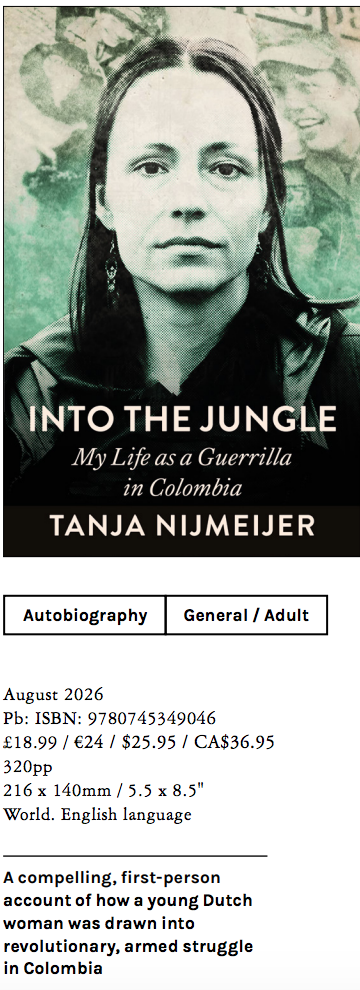
But in time, the organization became infamous for its crimes. It extorted money through so-called ‘revolutionary taxes’ (as Tanja Nijmeijer also notes in her memoir Van guerrilla tot vredesproces, published in Dutch in 2021 [English translation Into the Jungle: My Life as a Guerrilla in Colombia is due in August 2026], and through kidnappings. The FARC also maintained ties to the drug trade. Weapons and revolution needed funding from somewhere.
By the late 1990s, the group counted nearly 20.000 armed members and thousands of unarmed sympathizers and logistical supporters.
Most of these recruits were young — often in their twenties — drawn from poor families where brothers or cousins were already guerrilleros. For many, joining seemed almost inevitable. There were few other options; for countless impoverished youth, life offered no real prospects.
The Peace Agreement
After decades of conflict — which, according to Nijmeijer, left more than 200.000 dead, between 60.000 and 80.000 missing, and around eight million internally displaced people, with both the FARC and the government blaming one another — the FARC signed a peace agreement with the Colombian government in 2016. Nijmeijer herself was part of the FARC delegation.
Following the accord, the movement transformed into a political party, first under the name Fuerza Alternativa Revolucionaria del Común (keeping the same acronym, FARC), and later renamed Comunes in an effort to distance itself from its violent past.
Inequality and Injustice
Three years ago, I read Tanja Nijmeijer’s book about her time with the FARC, Van guerrilla tot vredesproces (2021). As a 22-year-old from the Dutch town Denekamp, she was confronted in early 2000s Colombia with the country’s deep divide between rich and poor; a corrupt society marked by inequality.
Studying Romance languages in Groningen, she traveled to Colombia to teach English at a school and later to complete an internship project. There, she came face to face with injustice — an encounter that gradually consumed her life. She joined the FARC’s war in the Colombian jungle from 2002–2012.
Fighting for the rights of the oppressed, violent resistance against hated oppressors — that struggle, once centered in Colombia, can be seen today in many other parts of the world.
A Source of Revolution
The Marxism and anti-imperialism that defined the FARC’s struggle against the Colombian government echo in other conflicts, such as the Israeli–Palestinian one — and in the way many Westerners attempt to whitewash groups like Hamas or the Palestinian Islamic Jihad (PIJ) as legitimate or even heroic resistance movements born of despair and ultimate victimhood. Armed struggle is framed as justified, the argument goes, because of the “theft and occupation of Palestinian land since the founding of the State of Israel in 1948.”
Palestine, in this romanticized narrative, becomes the new wellspring of revolution. Entranced by the mythology of violent, far-left resistance, activists portray Israel — the ‘powerful oppressor’ — as an enemy to be dismantled for the sake of a ‘just and free Palestine’.
In Israel, seen as Western, capitalist, and individualist, revolutionaries find the perfect foe; a state to be fought, if necessary, by the millions, and by any means, including violence.
This narrative resonates powerfully with politically engaged youth (the ones who never play video games, as cynics might say).
During a 2024 summer camp organized by the Socialist Youth of the Netherlands, Tanja Nijmeijer was interviewed live. A fragment of that conversation appeared in the magazine Paraat of the Socialist Youth:
A Revolutionary Chip
“They implanted a revolutionary chip in me in Colombia,” Nijmeijer says with a laugh. “I call it a process of awakening; my mother calls it brainwashing.”
Then she adds: “We laid down our weapons too quickly. I can be very brief about that.” In her view, the transition should have been gradual: “We should have given up ten percent, then waited for the government to implement the first reforms. Then another ten percent, and so on.”
‘The model she refers to — known as a “prolonged people’s war” — ultimately failed to achieve its aims. The great masses who were supposed to rise up alongside them never did. The Colombian government could demand that the FARC relinquish all its power precisely because that power had already dwindled to almost nothing.’
(…)
The article in Paraat continues:
‘Today, the government regularly introduces motions to have the pro-Palestine movement — in which we are deeply involved — monitored by security services and even designated as terrorist.
Specifically, the involvement of Palestinian communists in the Dutch movement through the organization Samidoun puts the socialist movement here in a precarious position, one that could easily lead to surveillance or prosecution.’
This, the Socialist Youth write, forces them to make choices:
‘How do we prepare for a possible future in which we increasingly come into conflict with the Dutch state — a state that pursues international power and capital?
(…) We could retreat into secrecy and illegality to protect our structures, or we could take a step forward and declare openly: we are revolutionaries. We stand against Israel and Dutch complicity. And the fact that you try to criminalize us only proves how vital this struggle is!
(…) If one day, like Nijmeijer, like the FARC, we are forced to take up arms — then may it be together with millions of others.’
It should come as no surprise, then, that during the peace negotiations in 2012, the FARC officially expressed solidarity with the (armed) Palestinian struggle. All in the name of a shared anti-imperialist fight.
A Why
Nijmeijer’s book remains fascinating from start to finish, also on a second read. It’s good she chose to share her story with a wider audience. After all, how does one explain that a 23-year-old woman from the small Dutch town Denekamp, raised in a loving Dutch family, decided to join the Colombian FARC, an organization she already knew was far from peaceful?
She answers that question herself.
Friedrich Nietzsche once wrote: ‘He who has a why to live for can bear almost any how.’ And indeed, Nijmeijer had ‘her why’. She sacrificed everything for it, including her personal freedom.
Her memoir also delves deeply into the peace process that took place over four long years, on Cuban soil, in Havana (2012–2016).
Weakening of the FARC
From her account, it’s clear that the FARC had little choice left. Its jungle militias were being relentlessly pursued by the Colombian army under President Álvaro Uribe’s Plan Patriota, financed by the United States. The leadership structure crumbled; commanders were killed in increasing numbers. The movement was weakening fast.
It became evident, even within the organization, that laying down arms was the only way forward in exchange for government commitments (let that be a lesson for other armed conflicts).
The FARC wanted an end to the endless violence and agreed to join the government for peace talks — not only because it was cornered, but because it realized the war had cost too many innocent lives on both sides. The vicious cycle of violence had to be broken.
As part of the peace process, the FARC agreed to acknowledge the suffering of its victims. Nijmeijer writes that they understood that without recognition of victims’ pain, there could be no lasting peace. A truth commission and a special tribunal were established to prosecute crimes, and a reintegration program was created for former guerrilleros to return to civilian life.
What Would She Say?
But what would the ex-guerrillera say if she read the breathtaking and soul-wrenching Even Silence Has an End? What words could one possibly find?
Thinking in terms of a ‘struggle against inequality and injustice’ suddenly feels hollow. Those ideals evaporate like morning mist. What do they still mean when, in the name of those ideals, people are kidnapped, tortured, and stripped of their humanity?
The Other Side
Ingrid Betancourt’s account offers the other face of the FARC coin — a testimony that will echo for a long time to come. She wrote a powerful survival story that made me shiver, yet also filled me with joy when, after multiple failed escape attempts in the spellbinding yet terrifying jungle, her hell finally ended through a daring rescue operation by the Colombian army.
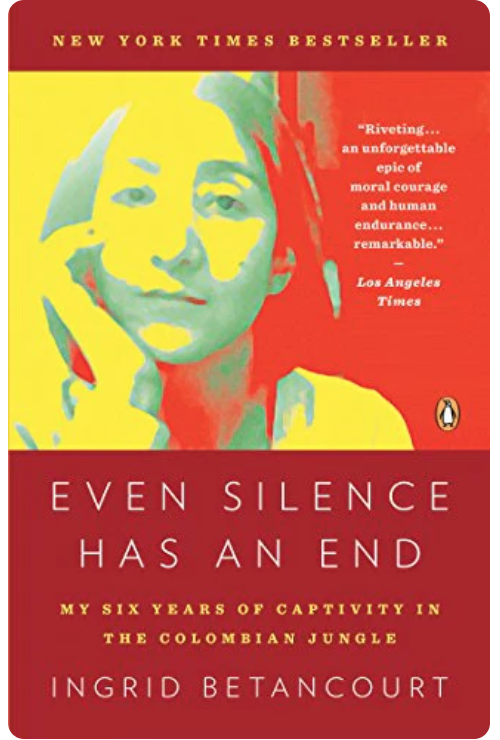
Betancourt had been abducted while campaigning for the Colombian presidency. Her captivity unfolded under excruciating conditions: chained first by the ankle and later by the neck, constantly moved from one camp to another — journeys that sometimes took days or weeks through dense jungle. She endured starvation, illness, and the unending uncertainty of whether she would live or die. She nearly did die, stricken with hepatitis, before being grudgingly granted medicine.
Her story is one of hell on earth, but also of liberation from that hell. It is about love and war, and what it means to remain human in the most extreme circumstances.
Betrayal, jealousy, fear, humiliation, abuse of power, deceit, manipulation, pain, affection, loyalty, forgiveness, the contradictions of human beings, the confusion she felt when her captors occasionally revealed traces of humanity — the devouring demons and the inner calm, her love for her family. She portrays every facet of the human condition because she was forced to confront them all.
“I had grown aware of how complex we human beings are. Because of that, compassion appeared to me under a new light, as an essential value for dealing with my present. It is the key to forgiveness, I thought, wanting to set aside any inclinations of vengeance.”
Support from a Few
Betancourt reveals how groupthink and peer pressure shaped the guerrilleros’ behavior. Only a handful showed her any real compassion. One young guard named Ferney told her:
“Ingrid, you must always remember what I’m going to say to you: if they treat you badly, always respond with kindness. Never lower yourself; don’t react to insults. Know that silence will always be your best response. Promise me you’ll be careful. One day I’ll see you on television when you regain your freedom. I’m waiting for that day. You do not have the right to die here.”
Soon after, the young and wise Ferney was transferred to another unit — he had grown too close to the hostage. His compassion was, sadly, an exception. Most guards took pleasure in the power they held over their captives.
They were young, indoctrinated with the necessity of violent revolution against the elite. And Betancourt, in their eyes, was that elite — a politician, the very embodiment of what they hated.
Ironically, her political party, Oxígeno, was a green and pacifist one that fought corruption and environmental destruction. One could almost think the FARC had taken the wrong person hostage.
“Politician. It was a word that contained all the class hatred with which they were brainwashed daily. Indoctrination was one of the commander’s duties.”
Brutal Violence
“Being a prisoner was bad enough. But being a female prisoner in the hands of the FARC was another matter entirely. It was difficult to put it into words.”
When Betancourt was recaptured after one of her escape attempts, she was treated with brutal violence. No female FARC members were allowed to be present during her punishment, she was told by one of her female guards. Whether sexual violence occurred is something Betancourt leaves unsaid — but the implication is chilling.
Obedience and Submission
The blind obedience and submission among the guerrilleros run like a red thread through Betancourt’s testimony.
“From time to time,” she writes, “one of the female guards would raise her voice to talk about communism, about how glad she was to have taken up arms to defend the people, about how women were not discriminated against in the FARC and how sexism was strictly forbidden. Then she would lower her voice to confide her dreams, ambitions, and problems with her partner. I realized she was afraid the guards might be listening. That’s how I learned that every conversation was monitored. Everyone was under scrutiny and obliged to report any suspicious behavior. Informing was an intrinsic part of their regime. They were all subject to it, and they all practiced it indiscriminately.”
Divide and Rule
“They’ve gone and put us on the list of terrorist organizations, but we’re not terrorists!” one commander once shouted at her.
Betancourt, who often resisted with dignity and refused to please her captors, would calmly reply — even at the risk of her life. “If you’re not terrorists, then don’t act like terrorists! You kidnap, you kill, you gas-bomb people’s homes, you sow terror. What else would you like to be called?”
Such defiance often earned her death threats — a bullet to the head, they’d say. She is candid in her book about her own behaviour, but she also describes how the guerrilleros deliberately provoked conflict among the hostages — divide and rule — to maintain control.
Survival
“I understood how crucial it was to entertain my body in order to be able to free my mind.”
She learned weaving from a kind-hearted guerrillero, studied the Bible and an old encyclopedia, and exercised to strengthen herself — until even those small freedoms were taken away. They tried to strip her of everything, but they never succeeded in breaking her completely.
What sustained her most were the radio messages she received from her children and her mother, who fought tirelessly in public to draw attention to her daughter’s captivity. That love — the daily proof that she was not forgotten — kept Betancourt standing with dignity through those long, brutal years.
Both Nijmeijer’s and Betancourt’s memoirs revolve around choice, freedom, and the absence of it.
One saw her freedom as a duty to fight for a better world — a duty she tried to impose on others — and in doing so, she lost her personal freedom. The other saw her lack of freedom as a chance to become a better human being.
“In this condition of the most devastating humiliation, I still possessed the most precious of liberties, that no one could take away from me: that of deciding who I wanted to be.”
A Shared Struggle
Betancourt is a survivor. Nijmeijer, depending on whom you ask, is either a terrorist or a freedom fighter, even a heroine. And that parallel world, the clash of ideals and identities, is still with us today.
In fact, we are witnessing something remarkable: the contemporary Marxist left has increasingly embraced the ideals of fundamentalist, revolutionary Islamic movements such as Hamas, citing a ‘shared struggle against imperialism and Western capitalism’.
Organizations like Samidoun, which allegedly maintains close ties with the Popular Front for the Liberation of Palestine (PFLP) — a Marxist-Leninist group known for violent airplane hijackings and listed as a terrorist organization in multiple countries — now glorify Hamas’s extremism as ‘revolutionary resistance.’
At protests, their flags often fly side by side: the hammer and sickle next to the green Hamas headband. During a recent pro-Palestine demonstration in Amsterdam, the Communist Committee of the Netherlands paid tribute to the Hamas ‘fighters,’ hailing them as ‘martyrs’.
One protest sign read: ‘Long live the resistance!’ above the image of a masked Hamas member with a Kalashnikov in hand, completing the revolutionary tableau.
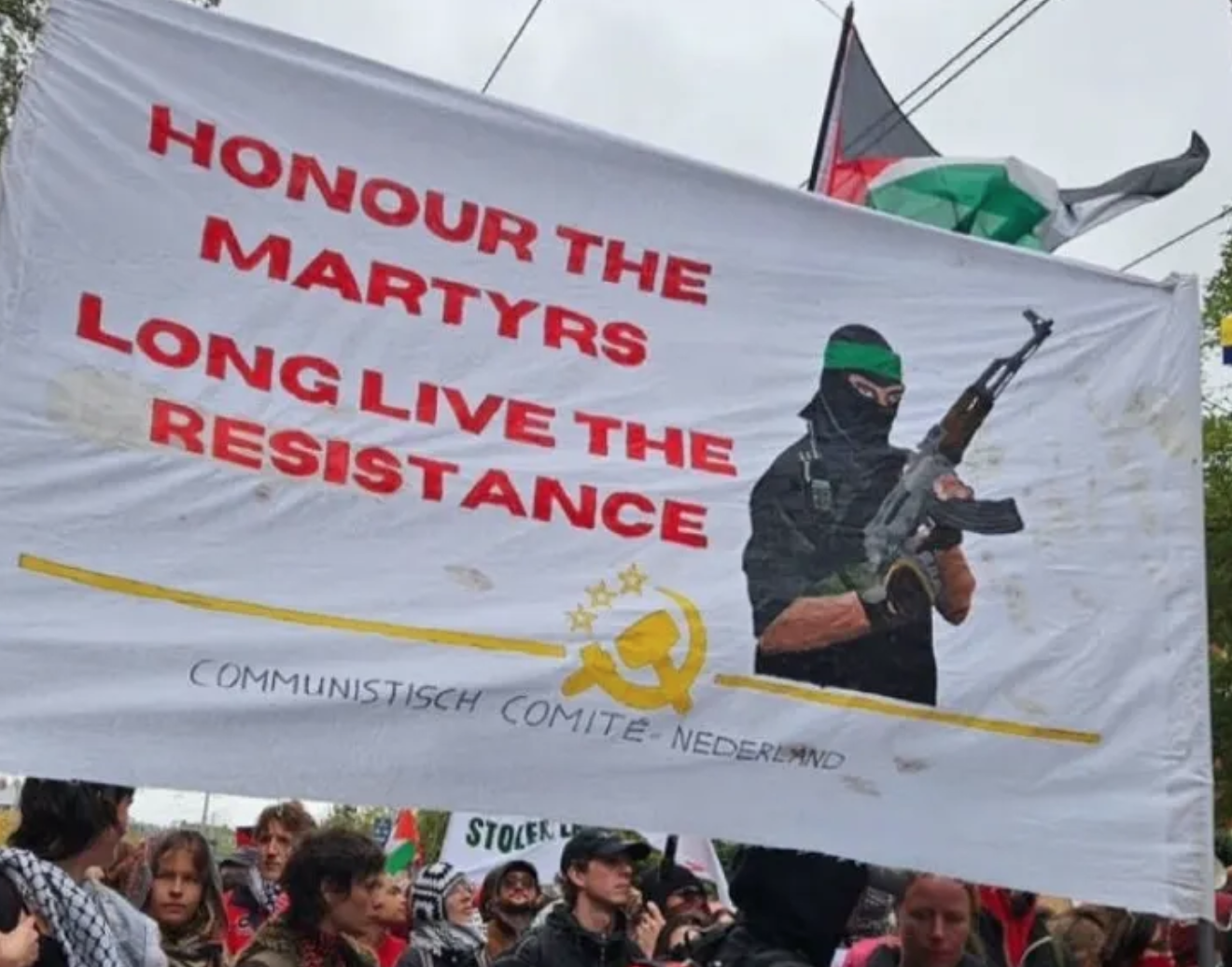
Yet as journalist Johan van de Beek, journalist and author of the book Sultan en de lokroep van de jihad (Sultan and the Call of Jihad) — about three young Dutch men who joined ISIS — points out, the romanticism collapses under scrutiny:
‘Hamas is a (terrorist) group that, when judged by objective standards (and by its own charter and the statements of its own leaders), according to evolutionary psychologist Geoffrey Miller, it is impossible to see it as anything other than far-right, reactionary, theocratic, fascist, sexist, racist, homophobic, transphobic, and antisemitic. There are no more red flags than that.’
Global Intifada
And yet, Marxist leftists today seem to have entered into a shameless pact with the far-right Islamists and jihadists of Hamas, united by a single common enemy they believe must be fought with violence: the West, capitalism, Israel.
All for ‘the greater good’.
Together they call for a global intifada.
That the followers of the hammer and sickle would themselves eventually fall victim to this diabolical alliance seems not to have occurred to them.
The Tragedy of Ideals
Ideals can drive people to self-sacrifice and to violence. What begins as a fight for justice often ends in repression, crimes, and the loss of humanity. This dynamic repeats itself endlessly across history and in conflicts still burning today.
Time and again, people fall into the trap of the ideal that becomes its own prison. A hell disguised as a heaven.
Also published on Medium.
Image: Alexandre Daoust on Unsplash.
For the Dutchies: I also write on Substack. This is my latest:
And some music on a Monday to bring on a beautiful week!
Con Amor, Eva

 ☆evalunes