It has been far too silent on here. It’s high time for new writings. This time a post in English. Below in Dutch as well.
~
We had bought tickets for The Odyssey, Christopher Nolan’s adaptation of the ancient Greek myth by the poet Homer. It now is a genuine box-office hit. Spellbound, sitting motionless in the seat of what was once my favourite theater in Rotterdam (the Netherlands), a place where the years seem to have stood still. It still breathes the cosy atmosphere of the 1970s. Plans to tear the whole place down never seem to get any further.
“You’re a man who needs to control your fate. But you cannot control this. You must give yourself to the storm, give yourself to Poseidon. And take your punishment. Give up the fight, give up control and live. It is a leap of faith you haven’t yet made, Odysseus.”
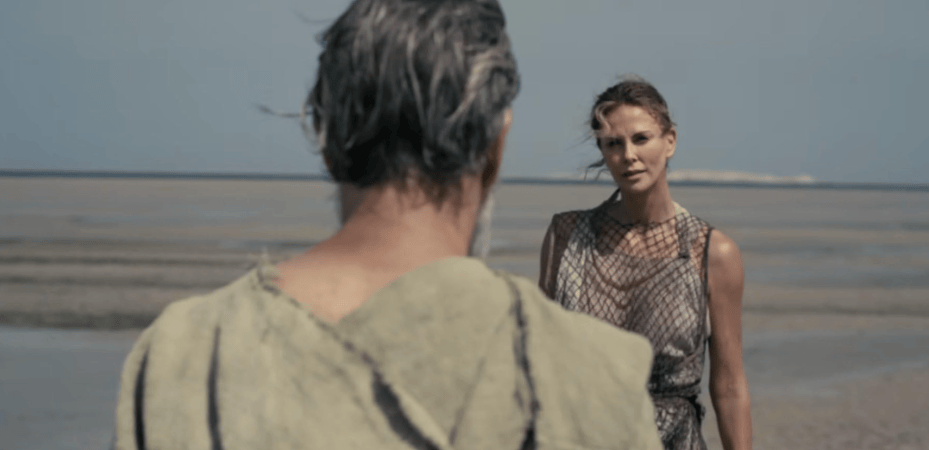
With these words Calypso releases the shipwrecked war hero and King of Ithaca, Odysseus, played by Matt Damon, after seven enchanting years on the island Ogygia where they have lived together. After the Trojan War, Odysseus, king of Ithaca, eventually returns to his wife, Queen Penelope, and his son, Telemachus, to an island that has fallen into ruin. Goddess Athena helps Odysseus on his journey, which takes him ten years. During his hellish travels home, Odysseus incurs the wrath of Poseidon, god of the sea, and battles all manner of dangers and monsters.
Charlize Theron plays Calypso. Her magnetic presence, surrounded by sea and sunlight. An almost otherworldly scene, and words that, in reality, are more earthly than one might imagine.
My eyes began to sting. “You must give yourself to the storm,” she tells Odysseus. Swept away from the — tragic— world. Away from the flames. From the cracking earth.
“Take your punishment. Give up control and live.”
A shiver. At the words of the extraordinarily beautiful sea nymph Calypso, the burning sting in my eyes gave way to a few liberating tears (Yes, I can be a sentimental person).
The lotus made him forget
During his years on the island of Ogygia, Odysseus eats the lotus flower. Calypso gives him the lotus, and according to her, he can’t get enough of it. It clouds his mind and makes him forget that he has to go home, where Queen Penelope and their son are waiting for him.
Calypso: “The lotus clouds the mind, saps the will, but doesn’t change who you are. You weren’t ready to go home for whatever reason.”
The lotus flower impairs his memory. In the movie, Calypso helps Odysseus understand why he stays on her island and why, ultimately, he leaves. Eating lotus gives him was a temporary escape from his past, from war, death and violence. Oblivion serves as a blanket to shield him from past traumas. The irresistible temptation to numb yourself and, for a while, simply forget. Seven years of it, until Calypso makes him see that he has to leave his numbness behind if he ever returns to Ithaca. He has to allow his memories in and carry on living. No more escaping, no more running away from himself, but returning home, where he belongs, to face the past. Odysseus builds a raft, the sea carries him away and, after ten years of absence, brings him back to the island of Ithaca.
For those willing to see them, Nolan’s adaptation of The Odyssey contains several messages or lessons. Go and see the movie yourself and you will discover what they are. This ancient heroic tale contains at least one lesson familiar to every human being.
Switching off discomfort
A life without pain, adversity, sorrow and regret is comfortable and tempting. In Aldous Huxley’s dystopian novel Brave New World, which comes closer to reality than one might think (because isn’t George Orwell’s 1984 the nightmare that is slowly becoming more real?), people take a substance called Soma, which intoxicates the mind and switches off the ability to experience discomfort. Huxley also describes the cinema, the Feelies, where the senses are stimulated and pain cannot be felt. Both serve to distract from discomfort, sadness, pain, boredom and the time needed to think. In Brave New World, this is arranged by the State. People do not have to suffer; the State takes care of that. And this gives citizens the impression that the need for freedom no longer matters. After all, they feel comfortable and are stimulated to such an extent that freedom ceases to be important.
Books are not erased, as they are in 1984, but they are no longer read. There is simply no need for them in Brave New World. People occupy themselves with constant distraction through consumption, entertainment, the Feelies and Soma. Both dystopian nightmares have become, to some extent, reality in 2026. Some schools in the US are banning Margaret Atwood’s The Handmaid’s Tale. But it’s a given nowadays that in most households Netflix-entertainment provokes considerably more enthusiasm than reading a novel does.
Numb yourself, feel, escape, forget, enjoy yourself and you no longer have to think about worries and problems, let alone memories of a painful past. The Western human being, forever burdened by endless to-do lists, may well have become rather skilled at it. Trouble and grief are inconvenient too, and should be dealt with immediately. Mourning because you had to say goodbye to someone you loved? A medical practitioner easily prescribes medication that affects the chemicals in the brain, flattening emotions and therefore making them more bearable. And if the doctor does not give you a pill, you can always find one yourself to escape the problems of everyday life or the rut of existence, and party until the sun comes up.
Not every problem can be solved. Sometimes the only thing you can do is accept what is. Calypso wants Odysseus to discover how to live with what’s impossible to change. Living with what cannot be changed, letting go, moving on and staying close to home. So he returns to the island of Ithaca, where he belongs. Back to Queen Penelope. Towards remembering and living with loss and responsibility as his destiny.
“Give up the fight, give up control and live.”
It is a universal message, and probably all the more powerful because of that.
Unfreedom
Odysseus didn’t realise that, for all those years, he was more or less a prisoner on the island of Ogygia. Unfreedom disguised by eating lotus, as Christopher Nolan has turned it into in his adaptation of the ancient Odyssey (around 750 BC).
The modern form of ‘unfreedom’ that keeps people ‘trapped’ looks more like the collectivist Soma than the individualistic Lotus. Institutions such as government and education, but also journalism today, are all guilty of clouding people’s minds. More often than one might think, they fail to show the world as it really is, with all its problems and crises. Events and crises are too often dressed in desired ideology, naturally with the very best intentions and with human rights supposedly at the heart of it all.
Such as: confusing war with genocide. Ignoring the fact that a man without any documents (he says he’s from Nigeria), who should never even have been allowed to remain on Dutch soil in the first place, murdered a young woman when she cycled home after a night out and committed other violent crimes against women, including rape. Instead, journalists prefer to write and speak only — even a year later — about the need for better lighting, cameras and cutting back bushes. Appeasing population groups who follow Allah, while abandoning others with remarkable ease. The assumption that perpetrators and victims cannot exchange places — or even worse, reversing the two and fixing that reversal permanently. Writing in stereotypes about what is supposedly unacceptable, while sometimes it seems perfectly acceptable (the times I see ‘white old man’ in serious Dutch newspapers is countless).
Visions become clouded, and stepping out of line in order to escape them often brings punishment. Everyone belongs and is allowed to be whoever he/she/they wants to be; that may be a humane creed, but apparently its exclusionary counterpart is still not recognised when it is inconvenient. Nor is there the will to recognise it, and so precisely the thing that people supposedly fight against ‘together’, keeps happening.
Isn’t it beautiful: The lotus flower turns out to symbolise the journey from darkness to wisdom and the overcoming of difficult times. We could all use some of that. The morally superior and the self-righteous could do with eating a little more of it; the journey from the depths towards the light is a long one.
So, let us have the lotus.
And afterwards, return home with a clear mind.
Also published on Medium
Dutch readers can click here:
Con Amor,
Eva


